Wednesday, May 11, 2016

Member Spotlight: Suzanne Paquette

We are back with another member spotlight!  This month, we are happy to present Suzanne Paquette who is a new"ish" member of the Guild.

Photograph by Vivian Doan Photography

Your social media coordinates (blog/website, Facebook, Instagram, etc):

You can find me online at:
http://ateliersixdesign.com/
https://www.facebook.com/ateliersixdesign/
https://www.instagram.com/the_milliner/
https://www.pinterest.com/the_milliner/
https://www.etsy.com/shop/AtelierSix

What did you study in school and/or what do you do for a day job?

In university, I studied fashion design and earned my BAA (Bachelor of Applied Arts) from Ryerson University in Toronto. Pretty In Pink was one of my favourite movies as a teenager and my plan at that point was to become a fashion designer. One thing led to another and I went from designing clothing to costume design, then to millinery (hats). I opened a retail store in Toronto on Queen St. West called Six Degrees and eventually moved to Montreal to work for Cirque du Soleil. Over my 13
years at Cirque, my roles within the merchandising department varied from buyer and product
developer to creative direction and project management.

In 2013, when I left Cirque, I took some much needed time off, and then decided to start my
second business – Atelier Six. In addition to doing design and business consulting work, I design
quilt patterns, and make modern memory quilts for clients.

How long have you been quilting?

I have been quilting for 3 years. Though I have sewn for most of my life (and still have and sew
with my very first portable sewing machine – a Kenmore – that I got for my birthday when I was
14), I just started quilting in 2013. Learning proper garment construction techniques, pattern
drafting and design fundamentals in university, as well as experience in costume construction has
really served me well in my quilting projects. There is still so much to learn for quilting specific
techniques and I’m always interested to see how different quilters approach their projects.

What first got you interested in modern quilting?

When my son was born in 2008 I knew I wanted to save his baby clothes to make a quilt. Up until
then, I had only seen traditional t-shirt quilts, which were not aligned at all to my personal
aesthetic or design style. I wanted to make a quilt that not only had great personal meaning for
me and my family but that also had a modern aesthetic that worked with our home. Around the
same time that I was thinking that modern memory quilts could be the focus of my new business,
a friend gave me one of Denyse Schmidt’s books for my birthday. Once I saw her designs, I knew
there was a place for me in the quilting world. Modern quilting was exactly what I wanted to do.

Photograph by Vivian Doan Photography

How did you find the MMQG and why did you decide to join?

I don’t remember exactly how I found the MMQG, but I think it might have been after I found the
MQG, and realized there were local modern quilt guilds. I looked up Montreal and found the
MMQG. I wanted to join to meet other local modern quilters.

Whose techniques/style/philosophy do you most admire in the modern quilting community?

I greatly admire Carolyn Friedlander’s architectural influence in her work – both her quilt designs
and fabric. I also admire all of her needle-turn appliqué, which is the polar opposite of my own
personal approach of sticking more to machine work.

Luke Hayne’s figural work on traditional quilt block backgrounds is very impressive. His work
really shows off his artist sensibility in the choices he makes, and it’s what I appreciate most
about his work.

Valerie Goodwin and Leah Evans both make stunning map quilts, something I would like to
explore more myself.

Yoshiko Jinzenji has a unique approach to quilting that I am drawn to. The second quilting book I
bought was her book ‘Quilting Line + Colour’. I love her technique of using organza as the top
layer of a quilt. It brings such dimension to her work and I was lucky to hear her speak and see
her work up close at QuiltCon in 2015.

Photograph by Vivian Doan Photography

Do you have any favorite quilting related social media accounts that you follow?

I follow a whole bunch of quilting related Instagram accounts. Some of my favourites are:


Where do you look for inspiration or ideas for your quilting projects?

Inspiration for quilts for me comes from everywhere. It’s easy for me to get caught up in a theme
and once I have an idea for a quilt, I research ideas obsessively. With Pinterest so accessible
and easy, I do tend to start there and I will generally search for references outside of the quilting
world. In the ‘old days’ I used to build inspiration boards from magazine tear sheets, then that
moved to saving files in a folder on my computer. Pinterest facilitates a lot. I take a lot of photos
as well and use things I see out and about as inspiration. There always comes a point though in
the design process when I stop looking at my references and let the design go where it needs to
go.


What is your favorite project that you have completed? Why is it your favorite?

My favourite project that I have completed is the first quilt I ever made with my husband’s clothing
and my son’s baby clothes. The pattern is called “Modern Arrow”. I love seeing all of my son’s
little baby clothes everyday. So many great memories. I can tell you that it was very hard to cut
into that first piece of baby clothing. Measure twice, cut once never felt so important as in that
moment! It’s much easier to cut into someone else’s baby clothes. ☺

There is a video about the making of that quilt here: http://ateliersixdesign.com/modernheirlooms/

What would you consider to be your quilting ‘superpower’?

I would say that my quilting ‘superpower’ is composition. Though I love asymmetrical quilts (and
asymmetrical design in general), it has to be balanced. Tension and balance go a long way to
making design successful I think.

Pattern called "Pique Nique" designed for Robert Kaufman.  You can download
it for free on the Robert Kaufman website.

What is your favorite part of the quilt making process? Why?

Piecing is my favourite, probably because it is a continuation of the design process. I generally
design my quilts in Illustrator before cutting anything out…especially since many of the quilts I
make are with other people’s clothing (which can’t be replaced). With my clients I want to avoid
major surprises with the finished quilt. But even once the design has been set on paper, there is
still some designing that happens during cutting and piecing. Seeing it life size calls for some
adjustment to the original plan.

Though I have a tendency to plan first, I also like improv quilting. I’m always looking for more time
to play with improv. Some really great things can happen spontaneously.

Photograph by Vivian Doan Photography

What project or technique is next on your “to try” list?

I’d like to play around with the ‘flowering snowball’ block and the ‘orange peel’ block. I haven’t
done a lot of quilting with curves, but I feel like it would be a lot of fun for me. Hat patterns are all
about sewing curves, so I feel like this is something that would feel familiar. The challenge of
using colour in an interesting way is also something that is appealing.

What is the best quilting tip or technique you’ve discovered?

Generally, I do all my binding by machine, and my favourite technique for getting perfect mitered
corners is this one: http://www.craftsy.com/blog/2014/09/how-to-bind-quilts/  I use this technique along with sewing the binding to the back first and then top-stitching the binding on the front of the quilt.


What is the best bit of quilting advice you’ve ever received?

The best advice was from Gwen Marston, which was basically “Make quilts your own way.”
When I saw her speak, she talked a lot about her own experiences of learning from more
experienced quilters, and then throwing caution to the wind and making quilts in the way that felt
right to her. It’s a good reminder to have faith in your own abilities and that you can carve your
own path, while still learning from other quilters around you.

Describe your creative process in three words:

Inspiration. Ideation. Edit + Refine. (OK, I cheated…4 words).

Describe/share pictures of your creative space:

We moved last August and my new (bigger!) workspace is still in the process of being set up.
These are photos of my previous workspace, which was part of our guest bedroom. It was small,
but effective. Large quilts were basted on the living room floor. And I really loved having a
mezzanine with 17’ ceilings in the living room – a great place to take quilt photos!

Photograph by Vivian Doan Photography


Thank you so much for playing along Suzanne!  I just loved getting to know you a little bit more.

Friday, May 06, 2016

Quilt blocks for Fort McMurray

The Ottawa MQG is organizing a collection of Maple Leaf quilt blocks to be put together into quilts and donated to those affected by the Fort McMurray fires.

Photo credit: slostudio.ca

The blocks should be made using blue, yellow, green, and/or red (the colors of the Alberta flag) on a light neutral/low-volume background. You can use solids or patterns, whatever you prefer, but please make sure the finished block is 12.5 inches square - it is important that all blocks are a uniform size so they can be put together easily. If you'd like a tutorial, SLO Studio from the OMQG has put one together here:

http://slostudio.ca/post/143920186032/maple-leaf-block-tutorial

I would like to call on everyone in the Montreal MQG to make one block to donate. If you wish to make more, or if you have quilt-y friends outside the guild who would like to donate, please feel free to do so! We will be collecting blocks at the May and June meetings.

Let's make this happen!!

Saturday, April 30, 2016

QuiltCon Charity Challenge 2017, part 2

As outlined in our first Charity 2017 blog post, Michèle and I are trying to motivate as many of you as possible to participate in whichever way you choose in this project. Together, we will create a memorable quilting experience together.

You can see in this year’s challenge rules that the color palette is predominantly blue, ranging from teal to indigo, with its complementary colours in yellow and shades of golden yellow, possibly accented with pink. The only neutrals permitted are snow white and silver gray.

The design challenge is to play with scale. A few examples of directions to explore on design include going very big to very small, or mixing several scales of a chosen design motif, as well as going for pixelation.

I suggested to Michèle to look at Ruth McDowell’s book ‘Pattern on Pattern’ as an interesting way of manipulating scale. Michèle will be bringing her copy of the book to the May meeting. Unfortunately I will not be able to attend, but my sketches and suggestions for an approach will be present. So bring your ideas and help map out our basic choice for motif. Each person can then develop her block or section individually into contributing components for our quilt top.

Then, in order to keep the creative juice for the project simmering over the summer, we are proposing two follow-up challenges to you:

Challenge 1  Color Play: Go through your stash and pull out prints that coordinate with the colours in this year’s palette in preparation for our first sew-in this fall. The posting QuiltConCharity Challenge: COLOR! for last year's challenge gives a very good tutorial on how to go about doing this.

Challenge 2  Design Exercise: Based on the scale and shapes decisions reached at the May 10th meeting, try your hand at sketching some possible overall quilt designs that could highlight the notion of scale by combining the different blocks or sections: try interlocking large and small scales of the selected motif and placing them using Alternative Gridwork. Get inspiration from the McDowell book, and take another look at this posting QuiltCon Charity Quilt: Alternative Gridwork for a refresher on gridwork.

May to August will be our Brainstorming phase:
  • Tell us what inspires you and what you have discovered. (All members) 
  • Tell us what expertise you like to contribute or new skill you like to learn by doing it for this project. (All members) 
  • Solicit vendors for material donation. (Anyone with good connection) 
  • Pick out prints from your stash that might work well with the palette of this year. (All members) 

Let’s have fun together!

- Lily

Friday, April 22, 2016

QuiltCon Charity Challenge 2017

We want your opinions for making this Quiltcon 2017 Charity Challenge fun! No sewing is needed before the fall, but a lot of thinking needed now...

The theme for this year's challenge is Scale; the approach for Mtl MQG might be Pattern on Pattern and we are thinking we could use HST's (half-square triangles) within rectangles or another proposed shape, depending on your suggestions. We thought you might want to pick a buddy to work with and inspire you.


Read the rules at the QuiltCon 2017 Charity Challenge website, and rummage through your stash for some prints that coordinate with the challenge's palette:


Then think, think, think and bring your ideas to the May 10th meeting (or post them below in comments). Tell us what you might want to learn, contribute or help us provide for this challenge.  

- Lily and Michèle

Sunday, April 10, 2016

I love my guild

I often tell people about "my guild"... and I use that term not because I am temporarily wearing the title of president, but because my guild, the Montreal Modern Quilt Guild and all of its members, is my source of inspiration, my creative outlet... my tribe.


I love my guild because... we support one another. We are a group of people who come from vastly different walks of life, different backgrounds, different situations, we have different tastes and opinions, and yet we get together every month; rain or shine, snow or heat wave, we gather together and support one another. We offer help, we offer a sympathetic ear, we offer resources and sometimes we offer sarcasm and tough love, but all with the goal of lifting one another up and seeing each other grow and succeed.

I love my guild because... we all have something important to offer. Each and every member of our guild, from the oldest to the newest, plays an important part and during our meetings it is amazing to see the worries and problems of the day left at the door as everyone spends a little time sharing part of themselves. Speaking in front of a group isn't always easy, but sooner or later everyone in the group opens up and shares that important bit of themselves, their voice and their viewpoint, that only they can bring to the group; and as a guild we become richer and stronger because of it.

I love my guild because... we create. These days it is all too easy to end up with a list of bookmarks and 'pins' a mile long and never get anything accomplished. But our group manages to juggle jobs, businesses, families, friends, obligations, responsibilities, growing children and aging parents, problems, celebrations and tragedies... and still bring something to share. It might be an epic finished quilt, it might be a half-finished tote bag, it might be only a single block or even just a word of encouragement... but we all create.

I love my guild because... we f*cking rock. Pardon my language, but we do ;) We represent so many different points of view, so many different levels of experience and so many different styles. I can't tell you how much I enjoy spending time with this group each and every month and see the things that you bring, hear the stories behind your works, share your joys and frustrations, and occasionally learn from your mistakes ;) I count myself incredibly lucky to be a part of this group; you inspire me, you motivate me, you challenge and educate me, and I am a better quilter and a happier person because of it!

We are not perfect... we make mistakes and have regrets, but as humans it comes with the territory. That's what seam rippers and the word 'sorry' are for. I happily count each and every one of you, imperfections and all, as part of my 'tribe' and I can't wait to see what we do next. :)

- stephanie

Monday, March 21, 2016

Weight of Love Workshop with Libs Elliot

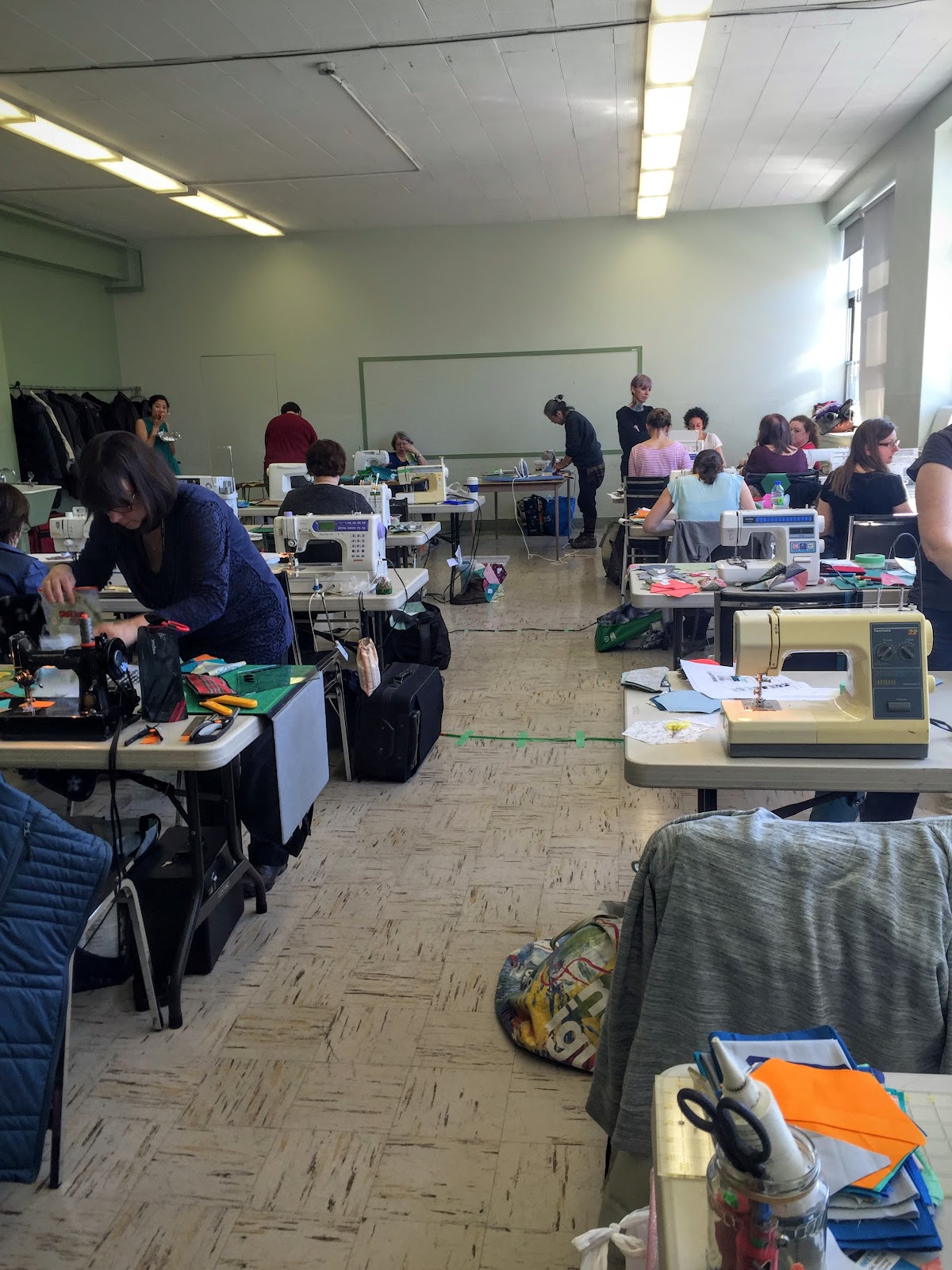
On Saturday, March 19, the MMQG had the pleasure of participating in a Libs Elliot workshop. Twenty-six of our members worked on the Weight of Love quilt designed by Libs.

The centre allowed us to use our "big room" and it worked out perfectly!


I think everyone had a great time and Libs was fabulous!


Lots of hard work, but also lots of fun socializing!


And although everyone was working from the same pattern, the fabric choices made a huge difference!  We ended up with a beautiful variety of colours.


And at the end of the day, we had a wall full of WIPs!


A big thank you to Libs Elliot, to Stephanie for organizing everything and to everyone who signed-up.  The workshop was a huge success!

Wednesday, March 16, 2016

Member Spotlight: Francine Benoit

C'est avec un grand plaisir de nous vous présentons Francine comme Spotlight pour le mois de mars. Francine est membre de la guilde depuis quelques années.  Un gros merci d'avoir accepté notre invitation Francine!


Vos coordonnées de médias sociaux (blog/site web, Facebook, Instagram, etc): 
Je ne suis pas vraiment sur les médias sociaux, sauf Facebook où j’affiche parfois mes courtepointes.

Qu'avez-vous étudié à l'école et/ou que faites-vous comme travail?
Depuis une vingtaine d’années, je travaille dans l’édition dans un centre de recherche universitaire en mathématiques et recherche opérationnelle.  J’utilise un logiciel de programmation typographique (LaTeX) pour éditer et mettre en page des textes scientifiques, contenant beaucoup de mathématiques, destinés à des journaux spécialisés.

Depuis combien de temps faites-vous de la courtepointe?
Je couds depuis que je suis toute jeune, mais je fais de la courtepointe depuis une douzaine d’années. J’accumulais les magazines, et je ne me décidais pas à me lancer, car j’avais toujours l’impression qu’il me manquait des notions.  Puis Courtepointe Claire a ouvert ses portes.  J’ai pris quelques cours et je n’ai plus arrêté la courtepointe depuis.


Qu'est-ce qui vous a d'abord intéressé à la courtepointe moderne?
Ce qui m’a d’abord séduite ce sont les couleurs, le design très graphique, les formes plus minimalistes, et l’improvisation, même si je n’en fais pas encore.

Comment avez-vous trouvé la MMQG et pourquoi avez-vous décidé de devenir membre?
Vous allez rire, mais je ne me souviens plus comment j’ai trouvé la MMQG.  Je me souviens que Cinzia Allocca avait quelques courtepointes à vendre chez Courtepointe Claire et je les aimais beaucoup.  Je suis donc allée voir son blog et j’ai découvert le monde parallèle des blogs et de la courtepointe moderne. Et je pense (!) que c’est là que j’ai appris l’existence de la guilde.  J’avais essayé de devenir membre de guildes plus traditionnelles, mais elles avaient des listes d’attente et des rencontres le jour seulement.  La MMQG est plus jeune, donc plus dynamique, et les rencontres sont le soir.  J’avoue avoir eu du mal à suivre au début avec tous ces noms de blogs et de designers de patrons et de tissus, mais à la longue tout se recoupe et se place.

Quelles techniques/style/philosophie aimez-vous le plus de la courtepointe moderne?
Au début je me suis cantonnée dans le style traditionnel.  C’était plus tangible pour moi.  Puis, j’ai découvert le site de Fun Quilts, aujourd’hui Modern Quilt Studio, de Weeks Ringle et Bill Kerr. J’adore leur style très graphique et leurs couleurs, parfois vibrantes, mais aussi parfois effacées ou analogues.  Leur série sur la transparence m’a vraiment conquise.


Quels usagers de médias sociaux reliés à la courtepointe moderne suivez-vous?
Aujourd’hui je suis vraiment beaucoup de blogs, même trop.  Quand je ne travaille pas, je passe plusieurs heures à éplucher tout ça.  Mais je dirais que j’admire beaucoup le travail de piquage de Judi Madsen de Green Fairy Quilts et Christina Camelli de A Few Scraps.

Où allez-vous pour de l'inspiration ou des idées pour vos projets de courtepointe?
J’adore les livres et les revues, il en traîne partout chez-moi.  Mais les blogs et Pinterest sont maintenant une belle source d’inspiration.  Je n’ai jamais étudié en design et je suis nulle en dessin. Mais je commence à voir des idées de blocs ou de design un peu partout (œuvres d’art, tuile, tapisserie).  L’idée du bloc pour ma courtepointe d’exposition vient d’une œuvre en papier que j’ai vu dans la vitrine d’un marchand d’art du vieux-Montréal.

Quel est votre projet favori que vous avez terminé? Pourquoi est-il votre préféré?
En fait j’en ai deux.  Le premier projet c’est « Tomatina », une courtepointe beige, noir et rouge.  J’en suis vraiment fière, car il y a une dizaine de sortes de rouge qui s’agencent très bien.  Dans mes premières courtepointes j’ai eu beaucoup de difficulté avec les couleurs et les valeurs de couleur.  Mais celle-ci est très réussie.  Quand je l’ai exposée au Salon 2010 de Courtepointe Québec, elle a gagné un ruban « Choix du juge » de Sheila Wintle. .  Le deuxième projet c’est la courtepointe qu’on surnomme « La courtepointe de Maman ».  C’est la seule courtepointe que ma belle-maman a faite dans sa vie et c’était pour mon conjoint, alors âgé d’une dizaine d’années.  Elle était très abîmée et Sylvain se demandait s’il devait la jeter.  Je lui ai alors proposé de retirer tout le piquage, mettre un molleton (elle n’en avait pas), remplacer le dessous et repiquer le tout. Je suis contente de lui avoir donné une deuxième vie.  Un article lui a d’ailleurs été consacré dans l’édition printemps 2015 du Journal de Courtepointe Québec.


Qu'est-ce que vous considérez comme votre 'super pouvoir' dans la courtepointe?
Je dirais que c’est ma patience.  Rien ne me fait vraiment peur en couture, mais, comme tout le monde, il y a des techniques que je ne maîtrise pas du premier coup.  Avec un peu de patience et un bon découseur, on arrive à tout.

Quelle est votre partie préférée du processus de fabrication de courtepointe? Pourquoi?
Je me suis souvent posé la question et je n’ai pas de partie préférée.  J’aime tout de la fabrication d’une courtepointe.  Mais dépendant des projets j’aime mieux certaines étapes que d’autres; parfois c’est la recherche des tissus, parfois le piéçage, parfois le piquage. J’apprécie aussi la pose du biais de finition à la main (surtout l’été dehors à l’ombre d’un arbre).

Quel projet ou technique est le prochain sur votre liste "à essayer"?
Je prends le métro pour aller au boulot. Et chaque matin j’attends le métro devant la murale de Judith Kleiss au métro Jean-Talon.  C’est une œuvre gigantesque (3 étages) composée de 192 carrés et seulement 6 couleurs, qui illustre la croisée des lignes orange et bleue du métro de Montréal.  Après avoir vu à la guilde la magnifique courtepointe de Sarah Bowman, qui schématise son parcours de jogging lorsqu’elle vivait à Montréal, l’idée a doucement germée de reproduire cette murale en courtepointe … en souvenir de toutes ces années.  Mais tout est rond dans cette murale, donc je dois maîtriser les coutures avec des courbes.


Quel est le meilleur truc ou technique que vous avez découvert?
Pour ma courtepointe « Tomatina », j’ai croisé différentes techniques pour faire des carrés formés de deux triangles (half-square-triangle) en piéçage sur papier et j’arrive à en faire de toutes les grandeurs en quelques minutes seulement et nul besoin de retailler après.

Quel est le meilleur conseil que vous avez reçu concernant la courtepointe?
Le meilleur conseil que j’ai reçu … avoir du plaisir.  Tout ça est un loisir qui me procure beaucoup de satisfaction et j’espère bien que ça restera ainsi très longtemps.

Décrivez votre processus créatif en trois mots:
Difficile, facile, difficile.  Mais attention je n’ai pas dit « pénible ».  Le choix des tissus est toujours difficile pour moi.  Comme je le disais je n’ai aucune base de design et les choix de couleurs sont assez ardus.  Par contre, quand le tissu et le patron sont choisis, l’assemblage est en général assez facile.  Puis viennent le difficile choix du piquage et son exécution.  Mais ici aussi la patience est mon alliée.

Décrivez/partagez quelques photos de votre studio ou espace de couture:
J’ai toujours eu un tout petit coin du sous-sol pour poser ma machine à coudre, mais parfois dans un sous-sol non fini, ou près de la fournaise, ou dans la salle familiale.  Mais depuis que les enfants ont quitté le nid, j’ai récupéré leur chambre.  En fait j’ai récupéré les deux chambres.  Ils avaient des chambres face-à-face séparées par les garde-robes.  Quand j’ai acheté ma machine à piquer « Gammill », aucune des deux n’était assez grande.  Mon conjoint a donc enlevé les placards, déplacé la porte et fait une seule grande pièce.  D’un côté de la pièce j’ai la Gammill avec tous mes tissus de courtepointe sur des tablettes au mur, et de l’autre côté il y a ma table de coupe, mes machines à coudre et d’autres tablettes au mur.  L’été dernier j’ai réaménagé le tout avec des meubles Ikea pour faire plus de rangement.  C’est ainsi beaucoup plus aéré.  Il y a des meubles à tiroirs des deux côtés sous la Gammill et, également des deux côtés, sous ma table de coupe.  Je suis vraiment chanceuse d’avoir un si bel espace et avec trois fenêtres j’ai toujours une belle lumière naturelle.


Thursday, March 10, 2016

Geometric Charm Swap

Inspired by our Molinari challenge, as well as the Riley Blake Sashing, the idea is to find a variety of unique twists on what a geometric print is. So there will be some prints which are out of bounds. 

Please, no polka-dots. While they are a geometric form in a geometric placement, it would be too easy to end up with a whole stack of polka-dots. Other circles are perfectly acceptable. Let's also avoid stripes, checks, and plaids, as well as the Riley Blake Sashing.

The goal is to find prints that others aren't likely to have already (though that may be difficult in some cases). Let's push the limits of the traditional geometric print! Have fun with the search, and discovery!

Each person who participates will be responsible for 5"x5" square of each of 2 different geometric prints, for all participants. For example, if 16 members participate, each will need to supply 16 (for the number of people) x 2 (1 of each print) = 32 charms.

The sign-up sheet is posted here. Since we're hoping for everyone to do some exploring, the exchange won't be until the May meeting, and the deadline for signing up will be the April meeting.

Here are some places to find inspiration, in case you're having trouble:
Fabric Spark has a whole section of Mid-century Modern prints with some great geometrics: http://fabricspark.com/collections/mid-century-modern
My Fabric Spot has a Geometrics section: http://www.myfabricspot.com/designer-fabrics.html?theme=155
Mad About Patchwork has a bunch of neat options, like the Abacus line by Alison Glass: https://www.madaboutpatchwork.com/collections/designer-fabrics/products/abacus-mercury-in-charcoal-1

Wednesday, February 24, 2016

Member Spotlight: Shannon Fraser

We are very excited to bring back the Member Spotlight and Shannon Fraser has graciously agreed to play along and share a little bit about herself.

Enjoy!


Your social media coordinates (blog/website, Facebook, Instagram, etc): 
You can find me online at a few places, including: my website, on Instagram, on Twitter and Facebook, as well as, on Pinterest.
 
What did you study in school and/or what do you do for a day job? 
I have always been a history buff! They were my favourite classes in both high school and Cegep. So after my year in cooking school, I decided to go to University and study history.  I’ve always considered education as just that – education and unlike many of my peers at the time, I didn’t want to go to school just to get a job. So I went and studied the French Revolution, English, Roman, Chinese and Japanese history. The latter actually lead to me spending a year in Japan teaching English, travelling, learning their culture and enjoying their seriously oishii (yummy!) food!!

How long have you been quilting? 
I have been quilting for less than a year, but I am hooked!


What first got you interested in modern quilting? 
I’m a fabric lover and I love being able to combine fabrics! So I set out to learn how to sew so that I could actually do something with the fabrics I loved! Jump ahead several years and I stumbled upon some quilting videos on YouTube and it was a total “aha” moment. I could pair lots of different fabrics and create something that was both pretty and practical – I loved that! Modern quilting specifically appealed to me due to the bright colors and bold designs. Plus I felt that there were less “rules” than in traditional quilting.  There was a freedom there that I felt I could make something my own.

How did you find the MMQG and why did you decide to join? 
While I was working on my first quilt, I really wanted to connect with other like-minded individuals and so I googled Montreal quilting and there you were!  Since I was such newbie, I wasn’t even sure if I would qualify to participate, but I felt welcomed from day 1, which is so awesome!

Whose techniques/style/philosophy do you most admire in the modern quilting community? 
This is a tough one! I feel like I am still in discovery mode, but I would have to say I am really taken by Kathleen Riggins from Kathleen Quilts – her quilting is so intricate that I am just in awe. I also really love Amy Sinibaldi’s work, it is quite different from my style, but she includes the sweetest little details which I adore. And I love the graphic and bold nature of Libs Elliott’s work.


Do you have any favorite quilting related social media accounts that you follow? 
OMG – I am following so many quilters feeds, it’s crazy!  But I just love seeing Nicole from Lilly Ella’s World, Vanessa Christenson, Karen Lewis, Sachiko from Tea Rose Home, Jamie Swanson and Christopher from the Tattooed Quilter show up in my feed – it makes me happy :-)

Where do you look for inspiration or ideas for your quilting projects? 
That is so funny, my last newsletter was all about finding quilting inspiration from interior design, art and fashion. Sometimes it’s the colour pairings, other times it’s the material of a dress or the lines of a tile that have me captivated and imagining how that would look in a quilt design.  


What is your favorite project that you have completed? Why is it your favorite? 
I don’t have that many quilts under my belt, but I would have to say the Dresden Plate quilt that is still a WIP has to be my favourite. My partner is beyond supportive and has spent more hours than I’m sure he cared listening to me ramble on about fabric options, quilting techniques and just me plain geeking out over anything quilty! I was surprised to find out that he really likes quilts, so I asked him if he would like me to make him one and he chose Dresden Plates as his favourite motif. Little did I know what I was getting myself into, but I’m thrilled I did. I have learned so much working on that quilt – the biggest one being that you never know what you can accomplish unless you give it a try. That and patience! Quilting is not a sprint it is a marathon and you need to pace yourself. Once I got the quilt top finished, I hummed and hawed for months whether to send it out to be long arm quilted or whether I should do it myself.  My machine is too small to handle a king size quilt, so I’m about to embark on big stich hand quilting! This may take me forever!  But I keep telling myself once it will all be done it will be well worth the time investment. And what an heirloom piece it will be!

What would you consider to be your quilting ‘superpower’?
My fearlessness! Except for client work, all of my quilts have all been a form of improv. I usually just have an image in my mind and that’s what I follow throughout the design process. I just dive in and figure it out as I go. This means my projects take a little longer, but I love mulling my options as I get to each step!

What is your favorite part of the quilt making process? Why? 
Hand binding! And it is such a pleasant surprise!  I honestly thought any type of hand work was going to be my least favourite part, but my first binding experience ever was on a client project and I wanted it to look primo, so I hand stitched the binding and absolutely loved it! I’m not sure if it’s because I was seeing all my hard work come to fruition, but I find it thoroughly relaxing and a contemplative moment in the quilting journey.


What project or technique is next on your “to try” list? 
I have been itching to get on the hexie bandwagon! I know they are everywhere at the moment, but they are just so darn cute I can’t resist! That and there is a painting that I saw a couple of years ago that I would love to recreate as a quilt.

What is the best quilting tip or technique you’ve discovered?
Chain piecing! For most quilters reading this, that’s probably a no brainer, but I hadn’t heard of it until I first saw the technique on YouTube by the Missouri Star Quilting Company. It seriously revolutionized all of my sewing projects, not just when quilting. Aside from that, I think it is so important not to feel daunted. There are so many talented quilters out there, that when you are beginning it can feel overwhelming or feel that you are not up to snuff.  That is one of the reasons I have loved our quilting community. I haven’t felt judged, just supported.  I love that.  :-)

What is the best bit of quilting advice you’ve ever received? 
To have fun and not to worry about perfection – the quilting police aren’t out to get us!

Describe your creative process in three words: 
Colourful, impromptu and true to my gut. More than three words, but that’s what came to mind. :-)


Describe/share pictures of your creative space:
My creative space is scattered at the moment! I have taken over the dining room, and our spare bedroom and part of the closet in the office! I have fabric stored everywhere! And I have been mulling how I want to set myself up for some time now so that things are more efficient. I have been scouring Pinterest for sewing room design ideas, which you can see here, and I will be sure to share with everyone once I’m all setup.  :-)

Thursday, February 18, 2016

Do you have a design wall?

With the Libs Elliott workshop fast approaching, many of us are up to our eyeballs in color palettes and have dozens upon dozens of triangles and hexagons strewn everywhere in our workspace. The other night, one of my cats jumped up on my lap with a bright pink triangle stuck to one of his feet. :P

While the worksheets included in Libs' instructions are definitely helpful in figuring out your colors and layout, if you don't already have one now might be a great time to consider a design wall. This will allow you to layout your ideas full size and move things around to find a design you really like. It is a really useful tool to have both when you have a set pattern you are following, like the Weight of Love quilt, but need to decide on the color layout and when you are experimenting with an idea and want to see how it looks different ways before sewing everything together.

You can make them as simple or as complicated, as big or as small, as movable or as permanent as suits you. My work space is fairly small, but I did manage to clear some wall space and simply hung a vinyl tablecloth, right side facing the wall, so that the fuzzy underside faces out. You could also use a flat flannel sheet or a piece of cotton batting; they even make flannel fabric with a grid printed on it. If you don't have the wall space to spare, wrap that flannel or batting around a piece of heavy cardboard, wood or foam core that can be stored away in a closet or under a bed when not in use.

For some inspiration on how to make a design wall that suits your workspace, you can check out our Design Wall board over on Pinterest, or check out one of the tutorials below. They offer a wide range of size, price and permanence which is great for those of us with limited time/space/money! ;) Also, if you have some tips or tricks to share on making a design wall, leave them in the comments!